


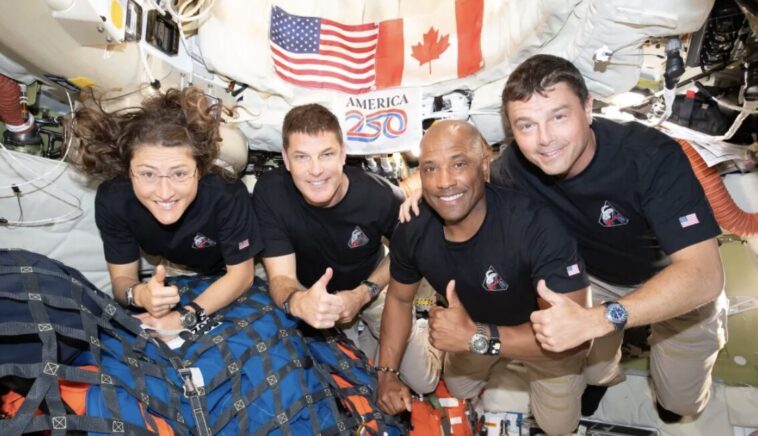
From backyard watch parties to packed beaches along the Space Coast, thousands of Floridians stepped outside on April 1 to witness history as NASA launched the long-awaited Artemis II from Kennedy Space Center. This mission marked the first crewed mission to travel beyond low Earth orbit in more than 50 years.
The launch, visible across much of the state, drew massive crowds along Florida’s Space Coast to watch the Space Launch System rocket light up the evening sky. For many, it was a once-in-a-generation moment echoing the Apollo era while signaling a new chapter in human space exploration.
A Mission to Space
Artemis II is NASA’s first crewed mission under its Artemis program, a broader effort to return humans to the Moon and eventually reach Mars. Unlike its predecessor, Artemis I, this mission carries astronauts: Reid Wiseman, Victor Glover, Christina Koch, and Jeremy Hansen.
Together, they are traveling aboard the Orion spacecraft on a roughly 10-day journey that loops around the Moon before returning to Earth. The mission does not include a lunar landing, but instead serves as a test of life-support systems, navigation, and deep-space travel capabilities.
Since liftoff, Artemis II has already begun setting milestones. With Koch being the first woman to travel into deep space, Glover the first Black astronaut to do so, and Hansen the first non-American on a mission of this kind. The crew is expected to travel more than 250,000 miles from Earth, which is farther than any humans have gone before.
As the spacecraft reached the Moon, astronauts captured never-before-seen views of the lunar far side and new high-resolution images of Earth. They will also observe potential landing sites for future missions, experience a temporary communications blackout as the spacecraft passes behind the Moon, and discover rare phenomena from deep space.
One of the mission’s most dramatic moments came during the lunar flyby, when Orion swung behind the Moon and lost contact with Earth for about 40 minutes. This was an intentional and critical test of deep-space communication limits.
A Safe Return
On Friday, April 10, the mission concluded with a parachute-assisted splashdown in the Pacific Ocean, where recovery teams retrieved the crew and spacecraft. NASA officials described the landing as a key success in proving the Orion capsule’s ability to safely return astronauts from deep space.
Artemis II is the first crewed mission in NASA’s Artemis program, which aims to establish a sustained human presence on the Moon later this decade. The next mission, Artemis III, is expected to attempt a lunar landing, marking the first time humans have set foot on the Moon since the Apollo era.
With the journey complete, the mission represents a major step forward in a new era of space exploration.





Comments