

Central Florida families have plenty competing for their time. Between work, school, sports, appointments, and weekend plans, learning CPR can easily become something people mean to do someday.
A new job or school program may be the reason someone eventually signs up. Parents, coaches, teachers, caregivers, and other adults may simply decide they would rather know CPR than keep putting it off.
Making room for a class can feel a little unusual. You are setting aside part of an ordinary day to practice for an emergency you hope never happens. Once the class begins, the subject becomes less abstract. You can touch the equipment, try the movements, and ask the questions that have been sitting in the back of your mind.
Orlando had an estimated 333,888 residents in 2025, according to the U.S. Census Bureau. Across a growing community filled with homes, schools, offices, gyms, sports facilities, churches, and public spaces, CPR is a skill that can be useful in many parts of everyday life.
CPR Certification Orlando has provided hands-on, in-person CPR training in Orlando since 2015, including American Heart Association BLS CPR classes for healthcare professionals, students, parents, teachers, coaches, caregivers, and other members of the community.
CPR Is Often Needed Close to Home
The American Heart Association reports that about 350,000 cardiac arrests happen outside hospitals in the United States each year. More than 70% happen in homes or residences.
That puts family members, friends, neighbors, and caregivers in a position nobody necessarily plans for. The person closest by may be the first person with a chance to help.
The American Heart Association also reports that immediate CPR can double or triple a person’s chance of survival after cardiac arrest. Those numbers are a good reminder that CPR is not only something that matters in hospitals or medical offices.
Knowing CPR can be useful at home, at a youth sports field, at the gym, at school, or during a normal workday. A parent may be near a neighborhood pool. A coach may be running practice. A coworker may be sitting across the break-room table. Many of us spend a large part of the week close to family members, coworkers, students, customers, or members of the public.
Hands-On Training Makes CPR More Familiar
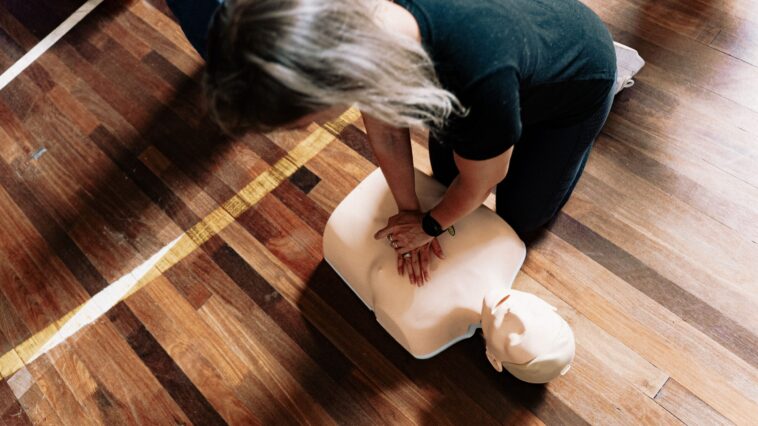
CPR is a physical skill. Reading about chest compressions can explain the basics, but putting your hands on a training manikin helps connect those instructions to something you have actually done.
Practicing gives you a chance to get used to hand placement, body position, and the rhythm of compressions. A few rounds on a manikin can show why posture matters and why CPR takes physical effort. Repeating the movements can also help build muscle memory.
A classroom gives you room to pause, reset, and try again. You can hear an explanation, put it into practice, and ask a question when something does not feel right. Small details often make more sense when the equipment is directly in front of you.
One class does not make anyone an expert. It does give you time to handle the equipment and practice the skills in person instead of seeing them only on a page or screen.
AED Training Belongs in the Conversation Too
Automated external defibrillators, usually called AEDs, are common in schools, gyms, workplaces, recreation centers, churches, and other public buildings throughout Central Florida.
A wall-mounted AED cabinet can fade into the background when you pass it every week. Many people have never opened one or seen the equipment inside. Handling a training device can make the real thing feel much less unfamiliar.
AED trainers let you hear the voice prompts, see how the pads are used, and get a better feel for where the device fits alongside CPR. A training unit does not deliver a real shock.
AEDs are designed to guide the user through the process. You do not have to memorize every prompt before touching the device. Hearing the instructions during training makes the sequence easier to follow and gives that familiar wall cabinet a clearer purpose.
BLS CPR Is an Option for More Than Healthcare Workers
American Heart Association Basic Life Support, commonly called BLS CPR, is widely used in healthcare and professional training. Nurses, dental professionals, medical assistants, healthcare students, and people in many other roles may need BLS CPR certification for work or school.
The course is also open to everyone. Parents, teachers, coaches, caregivers, fitness professionals, and other adults can choose BLS CPR when they want a full, hands-on CPR course from the American Heart Association.
BLS CPR includes CPR for adults, children, and infants, along with AED use and choking relief. At CPR Certification Orlando, the class takes about four to four and a half hours. Students who successfully complete the course receive their American Heart Association course completion card the same day, and the card is valid for two years.
Anyone taking a CPR course because of a work, school, or professional requirement should confirm the exact course needed with that organization. Those interested in BLS CPR can learn more about an American Heart Association BLS CPR class in Orlando.
A Few Hours for a Skill You Keep With You
CPR training does not have to become another complicated project on the family calendar. The class has a clear beginning and end, but the familiarity you gain can go with you almost anywhere.
Work may be the reason someone first signs up. For someone else, it may be family, coaching, caregiving, or simple curiosity. The reason can be different, but the CPR skills learned in class do not stay behind when the class is over.


Comments