


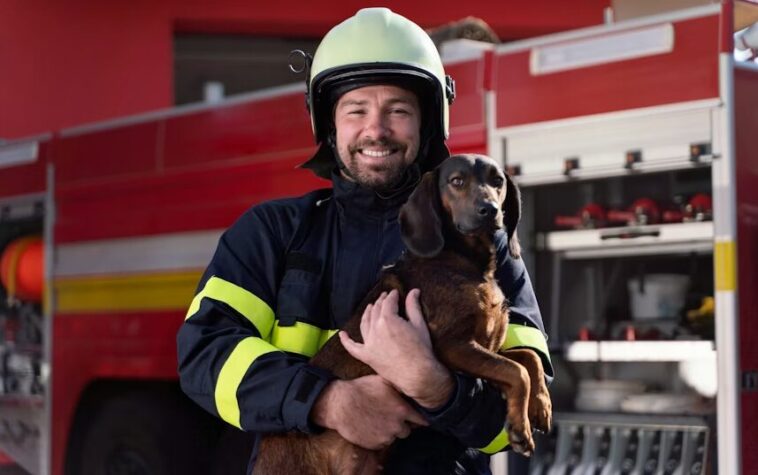
First responders face compounding psychological stress that standard wellness programs can’t proactively address. Gabrielle Franze, a Firefighter, Paramedic, and canine trainer based in Deltona, Florida, has spent years working at the intersection of both problems.
The call comes in at 2 a.m. By the time a firefighter returns to the station, the adrenaline has faded but something else has not. The image of the scene, the weight of the outcome, the residue of a decision made in seconds — these do not clock out with the rest of the shift.
For decades, the standard response to occupational stress in fire and emergency services has been resilience training, peer support programs, and the occasional employee assistance referral. These tools work if the first responder is willing to ask for help. None of them are available at 3 a.m. when a firefighter is sitting in the station kitchen trying to process the scene and unable to sleep.
A growing number of fire departments and emergency services organizations are looking at a different kind of resource: trained support dogs.
What Gabrielle Franze Has Observed on the Ground
Gabrielle Franze works on both sides of this issue. Every 3rd day, she responds to calls as a Firefighter and Paramedic with the Orange County Fire Department. The days in between, she runs Redline K9 Dog Training in Deltona, Florida, where she is an obedience trainer for dogs. She also works her own dog training for emotional support, search and rescue, and sports.
Her perspective is not academic. It comes from watching how a trained dog affects the energy in a room full of people. For people who have just come off something difficult, the shift happens when a trained canine gently nudges them, scoots in for a pet, or when simply sitting beside them. It doesn’t take much, but the impact is meaningful to our nervous system, allowing us to release the stress.
The difference, she has observed, is not dramatic. It is quiet. A dog that is calm and present lowers the temperature of an entire firehouse. It gives someone something to focus on that does not require a clinical framework or a scheduled appointment. It is available immediately and consistently.
That consistency is exactly what makes this approach worthy of serious consideration.
The Science Behind Why It Works
Research into animal-assisted interventions in high-stress occupations has grown substantially over the past decade. Studies published in peer-reviewed journals on occupational health and stress physiology consistently show that interaction with trained dogs reduces cortisol levels, lowers heart rate, and produces measurable improvements in self-reported emotional state.
For first responders specifically, the mechanism matters. Firefighters and paramedics operate in environments that keep the nervous system in a constant state of elevated activation for extended periods. That activation does not reset automatically when a shift ends. The body needs a trigger to begin the downregulation process. Support canines trigger the downregulation process almost immediately.
Physical contact with a calm, familiar animal is one of the more reliable triggers identified in stress physiology research. It requires no effort from the person, no verbal processing, and no appointment. It simply works because of how the human nervous system is wired.
This is not a replacement for clinical mental health support. It is something that functions in the gap between the acute moment and the next available professional resource.
The Difference Between a Pet and a Trained Support Dog
Not every dog is suited for this work. This is a point Gabrielle Franze makes consistently and one that matters for any organization considering a formal canine support program.
A dog placed in a high-stress professional environment needs specific behavioral preparation. It must be calm under unpredictable conditions. It must be reliable around equipment, noise, and multiple handlers. It must perform consistently, not only when the environment is controlled.
Franze’s dog Nova is certified as an emotional support service dog through the Orlando Health Hospital System. That certification reflects a documented standard of behavioral reliability, not simply a friendly temperament. It means Nova has been evaluated and approved to function in clinical and institutional environments where failure is not acceptable even if the environment becomes chaotic.
The training required to reach that standard is sustained and method-driven. Franze describes the foundation as trust-based: the dog learns through clarity and consistency rather than compliance through correction. A dog trained this way is predictable. In a profession where unpredictability is constant, that reliability carries real value and great comfort.
What a Formal Program Looks Like
Fire departments that have introduced canine wellness programs typically structure them around one of two models. The first is a station dog, a single trained animal assigned to a specific firehouse that becomes part of the crew’s daily environment. The second is a roving program, where a certified therapy or emotional support dog visits multiple stations on a scheduled basis.
Both models have shown measurable results in departments that have implemented them. Firefighters report lower self-assessed stress levels on days when a trained dog is present. Some departments have noted reductions in sick day usage in the months following program implementation and overall burnout.
The barriers to program adoption are real. Liability questions, budget constraints, the challenge of finding the right people and animals trained to the appropriate standards are all legitimate concerns. What addresses each of these concerns is exactly what Gabrielle Franze has built her practice around: structured training, documented certification, and a clear behavioral baseline that the dog maintains over time.
A Broader Application Still Being Developed
The emotional support use case is the most immediate application. But the same principles that make trained dogs effective in station environments also apply in longer-term recovery contexts.
Post-traumatic stress is a documented occupational hazard in fire and emergency services. Studies have found that the rates of PTSD among firefighters and paramedics are significantly higher than in the general population. Treatment approaches that incorporate animal-assisted components have shown promising outcomes in veteran populations facing similar conditions, and researchers are increasingly applying those findings to first responder groups.
Franze’s stated long-term goal for Redline K9 is to build structured training programs specifically designed around first responder mental health recovery. The distinction she draws is between support and therapy. Trained dogs are not clinicians. But in combination with clinical support, they can extend the reach of a wellness program into the daily environment in ways that scheduled appointments cannot.
That combination is where the most significant potential lies.
What Organizations Can Do Now
Fire departments and emergency services organizations considering canine support programs do not need to build a full initiative before taking any action. A practical starting point is identifying whether any personnel already own dogs that are, or could be evaluated for basic emotional support certification. A second step is researching programs in the region that offer working dog placement for institutional environments.
The standard to look for is documented behavioral certification from a recognized source, experience training dogs for high-stress professional settings, and a trainer who understands the specific demands of first responder culture.
On all three counts, the work Gabrielle Franze is doing in Deltona, Florida represents exactly the kind of model other organizations can look to. Her experience living inside both the emergency services world and the canine training world gives her a perspective and an established network that most programs, however well-designed, cannot replicate from the outside.
The mental health needs of first responders are not going away. The tools available to address them are growing. Trained dogs are one of those tools, and the case for taking them seriously has never been stronger.


Comments