



Most modern security cameras can see something after dark; the harder question is whether the footage will show what you actually need to know.
Imagine opening a motion alert from the far end of your driveway. A pale shape crosses the frame, but you cannot tell whether it is a person, a deer, or a branch moving in the wind. The camera has night vision, yet the clip has not answered your question.
Choosing security cameras with night vision starts with a more useful goal: decide whether you need to detect activity, recognize a person, identify color, or examine a close subject such as a package. Then match the camera and lighting to that job.
Compare IR, Color, and Spotlight Night Vision
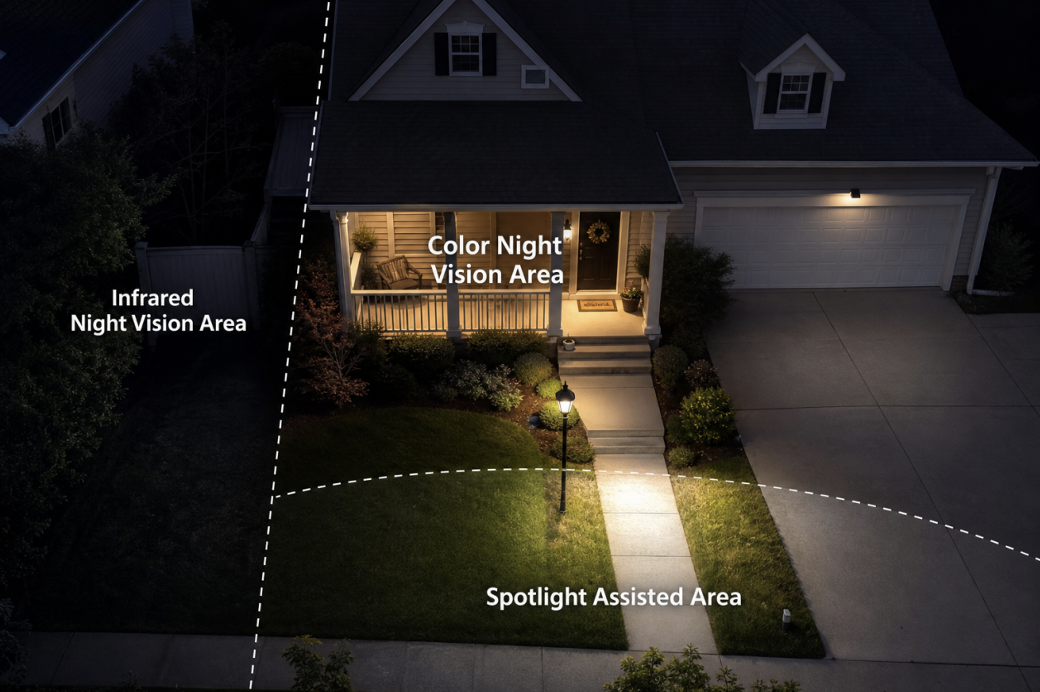
The phrase night vision describes a category, not one single technology. Infrared is part of that category. It is not the opposite of night vision, even though the two terms are sometimes treated as competing features.
Infrared Black-and-White Night Vision
An infrared security camera uses IR LEDs to illuminate a scene with light that people do not normally see. The camera switches to a monochrome view, so a dark side yard can remain visible even when there is no porch light, streetlight, or moonlight to help.
IR is practical for a dark gate, deep backyard, or unlit driveway. Its reach can be more consistent than low-light color modes because it does not depend on visible light. The tradeoff is color: a dark jacket and a red jacket may look similar in black-and-white footage.
Nearby walls, glossy soffits, spiderwebs, rain, and insects can reflect IR back into the lens, leaving a bright foreground and a murky subject beyond it.
Color Night Vision
Color night vision uses a sensitive image sensor, a wide aperture, image processing, and available light to keep a scene in color. Under a porch fixture or a steady streetlight, it may preserve details that monochrome IR loses: the color of a hoodie, a car, a backpack, or a delivery box.
This does not mean every color night vision security camera produces a clean image in absolute darkness. With little light, the image may become grainy, motion may blur, or an integrated light may turn on. Check the lighting conditions behind any sample image.
Spotlight-Assisted Color
A spotlight or white LED supplies the visible light that color imaging needs. It can improve close-range detail and may also make a visitor aware that the area is being monitored. For a front walk or a short driveway, that combination can be more useful than trying to brighten a poor image in software.
More light is not automatically better. A bright beam can disturb neighbors, flatten close facial detail, or make the background look darker. Use the lowest useful brightness, aim it inside your property, and choose motion activation when all-night light would be intrusive. If you are still comparing camera styles, eufy’s outdoor camera lineup shows how different power, coverage, and lighting approaches fit outdoor locations.
Match Night Vision to Your Yard’s Light
Do not begin with a claim such as “the best night vision security camera.” Walk the property after sunset. The same home may need more than one night strategy.
Start at the darkest boundary. An alley, back gate, or tree-covered side passage with no visible light is an IR-first location. Reliable black-and-white awareness is more valuable there than weak, noisy color. If color is important, plan a considerate white-light source rather than assuming the camera can create color from nothing.
Dim areas, such as a front door under a porch light or a driveway touched by a streetlight, can suit color night vision. Keep that light steady; repeated switching can force the camera to adapt at the wrong moment.
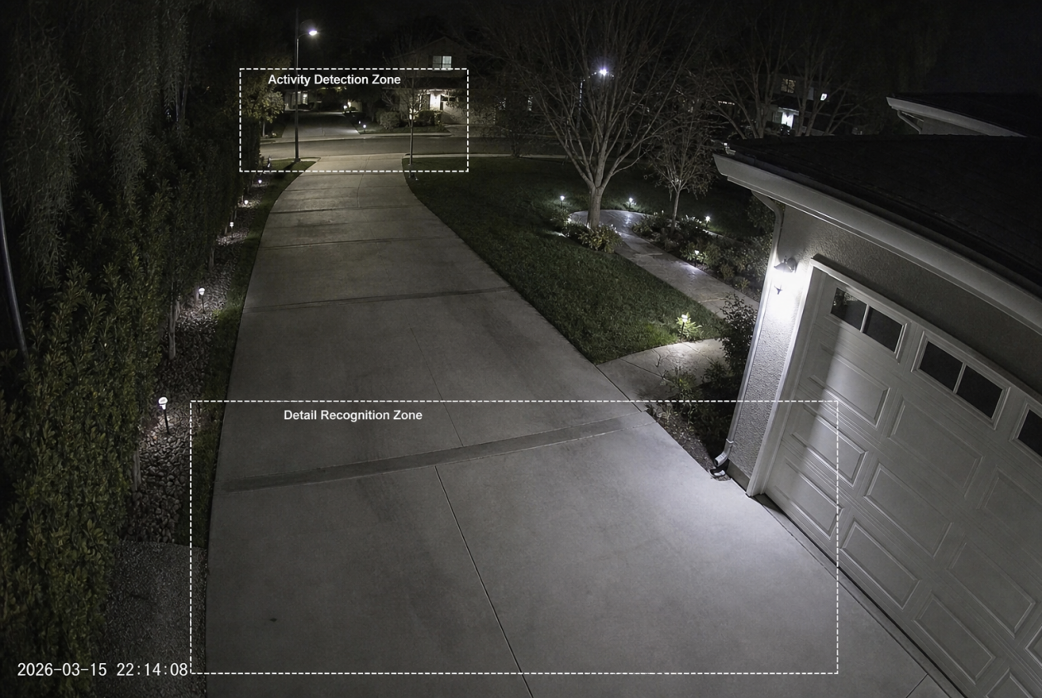
For a long driveway, separate the wide overview from the point where identification matters. A camera may detect a distant vehicle but capture useful detail only near the garage. Angle the recognition area toward the natural path of travel instead of asking one view to do everything.
A simple night walk gives you a workable map:
- No visible light: Favor IR, or add controlled illumination.
- Some steady ambient light: Consider color night vision.
- A close, high-priority approach: Consider motion-triggered spotlight assistance.
- A long driveway: Plan a wide overview and a nearer detail zone.
Why Night Vision Range Does Not Guarantee Identification
An advertised night vision range usually describes how far a camera can illuminate a scene or show activity under stated test conditions. It is a visibility or detection figure, not a promise that a moving face, license plate, or package label will remain identifiable at the same distance.
The UK government’s Police Requirements for CCTV Systems guidance recommends deciding exactly what a camera needs to show and then testing recorded footage under the conditions in which the system will be used. This matters because nighttime performance can change when a subject is moving, illumination is uneven, or headlights and porch lights create strong contrast. [Source: UK Government Defence Science and Technology Laboratory, Police Requirements for CCTV Systems]
Subject size in the frame, lens choice, viewing angle, motion blur, and backlighting all affect usable detail. Standard digital zoom magnifies recorded pixels; it does not recover fine detail that was never recorded.
If identification matters, create a closer detail zone instead of relying only on a long overview. Shorten the camera-to-subject distance, aim toward the natural path of approach, or add controlled lighting. The wide view can show that activity occurred, while the closer view helps reveal who or what was involved.
Fine-Tune Nighttime Coverage After You Choose a Camera
Fix Camera Placement Before Upgrading Specs
Before replacing a camera, clean the lens, trim branches that fill the foreground, and review the nighttime view from the installed position. Small changes can produce a surprisingly large improvement.
Avoid aiming at a porch lamp, reflective siding, or busy road. Keep faces large in the frame where people naturally pause. Light the subject from the front or side, and test while someone walks through the scene rather than judging an empty-yard still.
Power and network access also shape the installation. A wired location can support steady lighting and continuous operation. On an exterior wall without a convenient outlet, a battery or solar model may be easier to place correctly. For example, SoloCam S340 offers a solar-powered route for a garage side or detached area where new wiring would be awkward.
Reduce False Alerts After Dark
Night footage is only helpful if you can find the event that matters. Moths near IR LEDs, moving branches, rain, and headlights sweeping across a driveway can all trigger unwanted alerts. Activity zones can exclude a sidewalk or a neighbor’s property, while human and vehicle detection can reduce the number of clips you need to check.
Activity zones and object detection can reduce irrelevant notifications, but nighttime conditions can still produce false alerts. Review sensitivity after windy nights and seasonal changes. If supported, keep a broad recording area while using a narrower notification zone.
Use Local Storage for Night Footage
Night vision and cloud subscriptions are separate decisions. A camera can record after dark and save clips locally without a required monthly fee, provided the model includes internal storage, a memory-card option, or a compatible local hub. Cloud backup can still be useful for off-site redundancy, but it should be a deliberate choice rather than an assumption hidden behind the camera price.
Check storage capacity, overwrite behavior, encryption, event access, and offline behavior. You can also browse eufy security cameras by installation type and storage approach before narrowing the list.
A Multi-Zone Option for Connected Yards
Some properties do not divide neatly into separate camera zones. The front door, driveway, and yard may share the same approach, so one camera position may need to keep the broader route visible while following movement between areas. For this kind of layout, eufy’s eufyCam S4 combines a fixed overview with PTZ coverage. It pairs an upper 4K bullet lens with a 130° fixed wide view and a lower dual-lens 2K PTZ camera that tracks movement and adjusts framing.
For night use, its spotlights support color night vision, which suits areas where visible light is acceptable and color detail near the house matters. Results will still vary with mounting angle, subject distance, weather, and the yard’s lighting.
It can work independently, with no HomeBase required, and includes 32 GB of built-in local storage. A separately purchased microSD card can expand capacity up to 256 GB. On-device human, vehicle, and pet detection helps sort nighttime activity. The paired views suit movement from a driveway toward a door, preserving both route context and a closer look.
Mount it where the fixed lens sees the transition area, point the PTZ home position toward the key approach, and keep the spotlight out of neighboring windows. Then run several walking tests after dark. A useful setup answers your home’s recurring questions, not just produces a dramatic demo image.
Conclusion
IR, color night vision, and spotlights are not a ranking from basic to premium. They solve different lighting problems. IR is dependable in darkness. Color becomes valuable when there is enough light to support it. A spotlight can create that light, but only where brightness is welcome.
The right choice starts in your yard, not on a specification sheet. Identify the darkest zones, shorten the distance to the details that matter, and decide where visible light is appropriate. Do that first, and outdoor security cameras with night vision become much easier to compare without paying for impressive features your property cannot use.


Comments