

A Central Florida clinician on what twenty-eight years of working with families has taught him about ADHD — and how a tool called brain mapping is quietly changing the conversation.
In twenty-eight years of sitting across from families here in Central Florida, I have lost count of how many times I have watched the same scene unfold.
A mother describes her son. He is brilliant with LEGOs, encyclopedic about dinosaurs, hilarious at the dinner table. Then, quietly, she begins to cry as she tells me what homework looks like in their house. She is not crying because she does not know how to help him. She is crying because she has tried everything she can think of — charts, timers, rewards, consequences, tears, prayers — and nothing is working. Watching him struggle is breaking her. And someone, somewhere along the way, has told her, again, that he just needs to try harder. What should take an hour or two moves well past bedtime, leaving parents exhausted and kids frustrated that they never got to play, even a little.
I see a version of that mother almost every week. Sometimes the child is a daughter who disappears into daydreams or la-la land instead of melting down. Sometimes it is a teenager who aced elementary school and is now, somehow, failing ninth grade, badly. Sometimes it is an adult who walked into my office at forty-two thinking they were simply bad at life or they’ve struggled for so long and it’s finally caught up. The details change. The exhaustion is always the same.

I can trace my start in this field back to 1998, when I was a junior at UCF. It was there that my professor, Dr. Phillip Tell (teacher turned mentor) first showed me how truly dynamic the brain is when he covered “brainwaves,” or EEG. My path into ADHD, however, was not a straight line. My early years took me somewhere very different from the clinic I run today. I worked as a Victim Advocate with the State Attorney’s Office 9th Circuit at the Orange County Courthouse downtown — in the domestic violence, sex crimes, and homicide units — and later as a therapist doing in-home and at-school work with kids and families in underserved parts of Central Florida. I do not bring that up to dwell on those years. I bring it up because it is where I learned something I have carried into every room I have sat in since: behavior almost always makes sense, if you know how to listen for it.
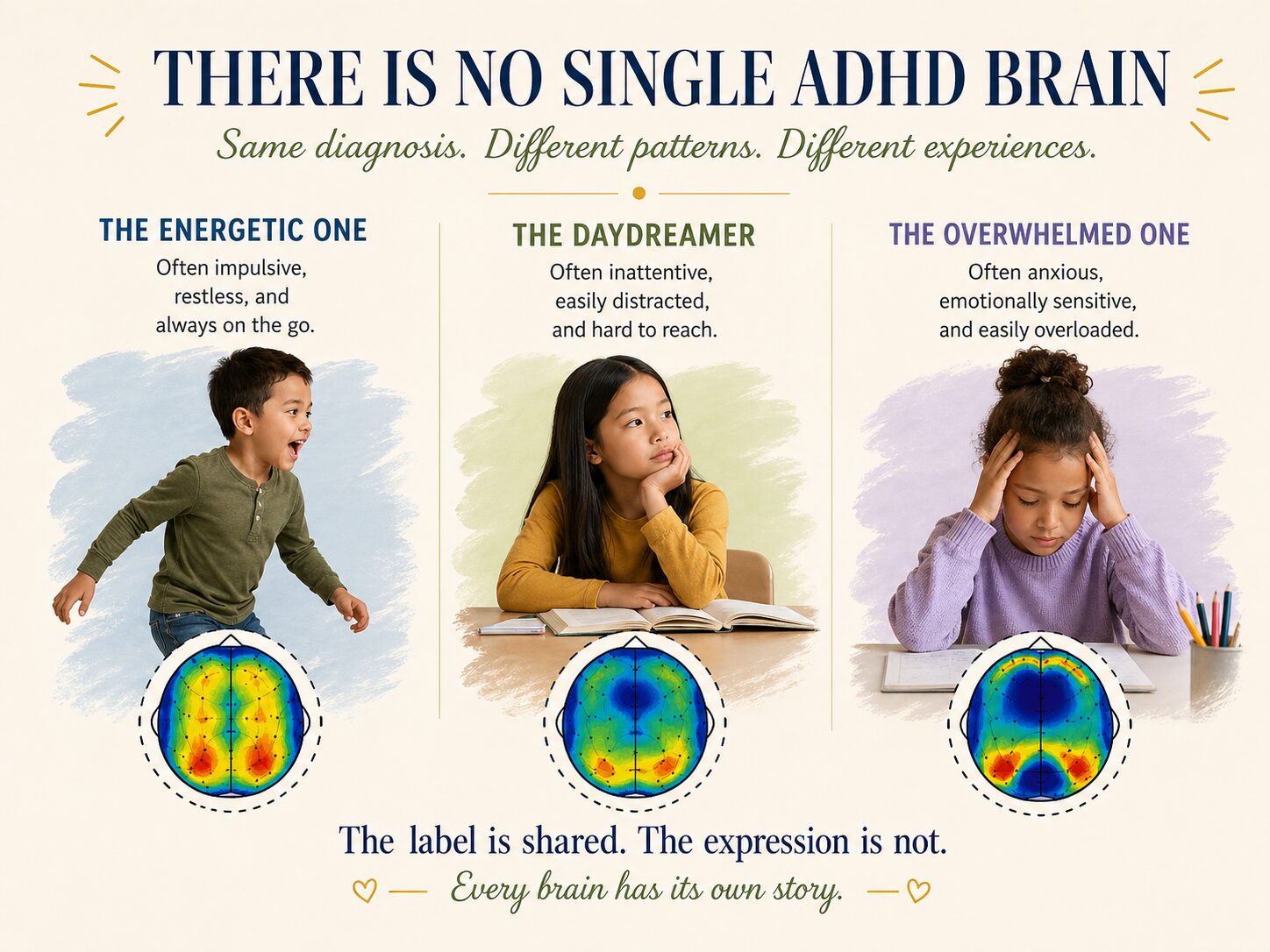
That lesson is what led me, eventually, to the work I do now. Because here is what I can tell you after almost 3 decades of this: there is no single ADHD brain.
We talk about ADHD as though it were one thing. It is not. Two children can carry the same diagnosis and look nothing alike. One bounces off the walls; the other stares out the window. One interrupts every sentence; the other has not finished one all week. The label is shared. The expression is not, they manifest differently. And the standard advice — “have you tried a chart, a timer, a stricter routine?” — fails more families than it helps, because it assumes ADHD is one problem with one solution.
It is not, which is why I have spent so much of my career looking for better ways to understand what is actually happening in each individual brain, rather than just managing the behavior it produces.
That search is what eventually led me to a tool called brain mapping.
I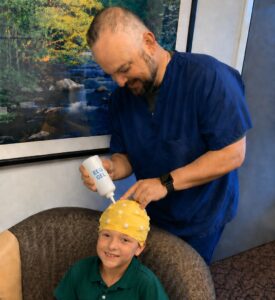

A brain map is not a diagnosis. I want to be clear about that, because I have seen parents told otherwise and it does them no favors. We can say it looks like, acts like, or presents like, but ADHD is diagnosed clinically — through history, observation, and careful evaluation. What a brain map can do is add a layer of true objective information to a conversation that, for most families, has been anything but objective for years, just checklists of symptoms that meet certain criteria.
That matters more than it sounds. When a mother has spent six years being told her daughter is just anxious, or just lazy, or just difficult, being able to look at an actual pattern of brain activity and say, “this is why reading feels so hard,” or “this is what is happening during those meltdowns” — that is not just a chart. That is the beginning of a different kind of conversation. One that moves a family from blame into curiosity. One that helps a clinician tailor support to this child, not a generic version of the diagnosis.
It is also, quietly, what has made certain approaches like neurofeedback — gentle brain-training techniques built on what a brain map reveals — a meaningful option for some of the families I have worked with over the years. But that is a longer conversation, and one I am happy to have when the time is right for you.
For now, if you are a parent reading this at your own kitchen table, wondering whether your child’s struggle is really what people keep telling you it is — or if you are an adult who has spent your whole life feeling like you were running uphill for no good reason — I want you to know two things.
One: what you are seeing is real. You are not making it up, and neither is your child.
Two: there are more thoughtful tools available to you than there were even ten years ago. You do not have to settle for explanations that do not fit.
If you have been carrying questions about any of this, you are welcome to call our clinic in Lake Mary and simply ask. No appointment required, no pressure to book. Sometimes the most useful thing a family can do is talk to someone who has sat in this chair long enough to hear the question beneath the question.
Twenty-eight years in, that is still the part of this work I love most. It has never really been about technology. It has been about the families. It always will be. That, I can proudly say, is a pinky promise I’ve kept with every kiddo I’ve ever been lucky enough to work with — only because a parent took a leap of faith and picked up the phone to ask.
Adrian E. Quevedo, MS, NEI, is Co-Founder of Kerov Health in Lake Mary. A University of Central Florida graduate with a Master’s in Psychology and Counseling, he has worked in clinical psychology, trauma-informed care, and neurofunctional health for more than twenty-five years. Certified in quantitative EEG and neurofeedback since 2002, he is a named inventor on a U.S. patent for physiologically modulated visual entrainment technology. Kerov Health serves children, teens, and adults through qEEG brain mapping and related brain-based care. He is also clinical director of Kerov.org, a 501(c)(3) nonprofit organization conducting research for Autism, PTSD, and gut health support.
Questions? Call 407-708-3200 or visit kerovhealth.com.

