


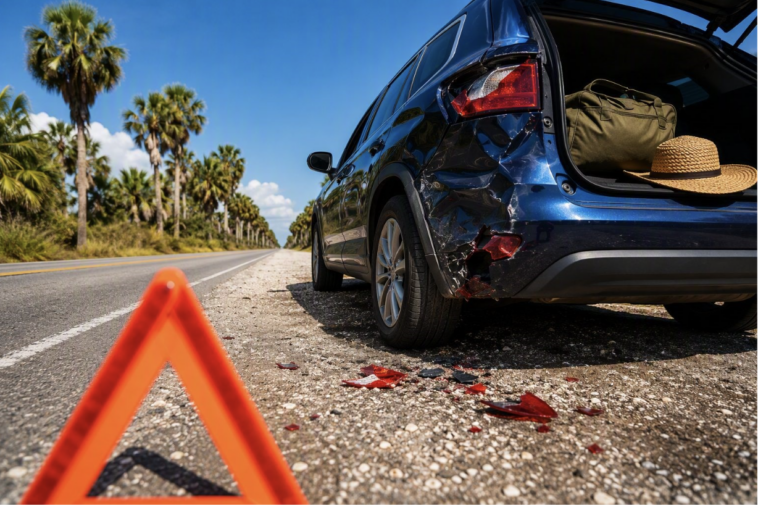
You’re three hours south of Orlando on Florida’s Turnpike when a crash drops you into unfamiliar territory: roads you don’t know, hospitals you’ve never heard of, a dispatcher asking where you are. If someone could be hurt, or the roadway isn’t safe, call 911 and do as the dispatcher says. Turn on your hazard lights if you can. Then wait somewhere protected.
Keep in mind this 2026 guide offers general safety and legal information; it isn’t individualized legal advice or a live incident bulletin.
What to Do After a Miami Car Accident Today
1. Check for Injuries and Call 911
Check yourself and your passengers. Don’t try to diagnose anything. Call 911 for possible injuries or fire, a blocked roadway, or any dangerous conditions. Report suspected impairment or a hit-and-run, too.
Miami-Dade Fire Rescue handles emergency medical response. Tell the dispatcher what you see and follow their directions. Leave a seriously injured person in place unless staying there creates an immediate danger, such as fire.
2. Get Out of Moving Traffic If It Is Safe
For property-damage-only crashes, Florida Statutes § 316.061 requires you to stop and stay at the scene until you’ve met your obligations. When a damaged vehicle obstructs traffic, the driver has to make every reasonable effort to move it or have it moved. Pulling off safely nearby is fine; leaving is not.
Miami-Dade expressways come with narrow shoulders and complicated interchanges, and heavy rain makes both worse. If injuries are possible or moving the vehicle seems unsafe, follow dispatch instructions. Don’t stand between vehicles or cross active lanes to take a photo.
3. Let the Crash Location Determine Who Responds
A Central Florida address doesn’t determine who responds. Call 911 and give the crash location precisely; dispatch routes the call to whichever agency handles it, whether that’s Florida Highway Patrol, the Miami-Dade Sheriff’s Office, or a municipal police department.
Give the road name and direction, then the nearest exit or mile marker. On local streets, fall back on a cross street or a visible landmark. Your Seminole County mailing address won’t pinpoint you on a Miami interchange.
Under Florida Statutes § 316.065, you must report crashes involving injury or death, or apparent property damage of at least $2,000, to police immediately. Get the incident number and report instructions from the responding officer. For an eligible minor crash with no investigation, follow FLHSMV’s crash-reporting instructions under § 316.066, including the 10-day written-report requirement.
That report follows the claim everywhere it goes: insurers read it before paying anything, and any dispute that drags on gets built on it. And if you’re sorting out the legal aftermath of car accidents in Miami today from your home upstate, the report and scene evidence do the local legwork you can’t do from 200 miles north.
4. Exchange Required Information Without Debating Fault
Florida Statutes § 316.062 says to give your name and address, plus the registration number of the vehicle you’re driving. If you have it, show your driver’s license when asked, and provide the required information to the investigating officer. The statute also requires reasonable assistance to injured people, including arranging necessary or requested medical transportation.
Grab the other driver’s insurer and policy number while you’re at it, plus a reliable phone number. Photograph the license plate and jot down the vehicle’s description. Stay factual. Skip the blame debate, and never sign a roadside payment agreement.
5. Photograph the Scene and Find Witnesses
Do this after addressing immediate safety. Useful photographs show where the crash happened, vehicle positions, damage, and road conditions. Wide views first, before anything moves, but never at the cost of delaying a required move or standing in traffic.
Then get close-ups of damage to each vehicle and its plate, followed by nearby signals and lane markings. Photograph debris and skid marks, plus weather-related conditions. Document visible injuries only with consent. Ask witnesses for names and contact details without pressuring them into recorded statements.
Keep the originals, including dashcam footage. Back up photos and videos without cropping or editing the saved files.


Comments