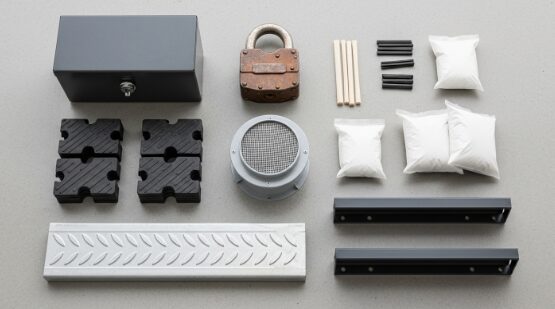
The right accessories turn a bare steel box into a properly functioning workspace or storage unit
A shipping container fresh off delivery is a capable but fairly basic thing. Four steel walls, a floor, two doors, and a handful of standard air vents. What makes it genuinely useful for a specific purpose is what you add afterwards.
That might be security hardware to protect what is stored inside. It might be ventilation to prevent condensation building up and damaging stock. It could be a ramp to make loading practical, levelling equipment to deal with uneven ground, or racking to keep the interior organised. None of these are complicated modifications, but the difference between a container with the right accessories and one without them is significant.
This guide covers the accessories that make the biggest practical difference, what each one does, and what to think about when choosing between options.
Security: lock boxes and padlocks


The standard locking arrangement on a shipping container is a set of locking rods on the door, fastened together with a padlock through a hasp. It works, but it leaves the padlock exposed. Angle grinders and bolt croppers make short work of exposed shackles, particularly on a site where nobody is watching overnight.
A lock box changes that equation. It is a thick steel housing, either welded or bolted to the door, that encloses the padlock so only the underside is accessible. To attack the padlock, a thief would need to be underneath it with cutting equipment — a considerably harder proposition than a quick swipe with a cropper.
Most new one-trip containers arrive with a slim-line lock box already fitted. Used containers often do not, and bolt-on versions are available as a retrofit if you do not have access to a welder on site.
The padlock matters as much as the box. A standard curved-shackle padlock will not fit most lock boxes, which are designed for straight-shackle or disc-style locks. Look for a padlock rated to at least CEN Grade 3, which indicates it has been independently tested for resistance to cutting, drilling, and picking. The shackle should be hardened boron steel or equivalent — standard steel shackles are vulnerable to cropping even on otherwise well-made locks.
The Sold Secure scheme rates padlocks and security products through independent testing. For containers holding anything of significant value, a Gold-rated lock is worth the additional cost.
Ventilation: air vents and condensation control
Condensation is the most common cause of damage to goods stored in containers, and it is almost entirely preventable with the right approach. Steel conducts heat rapidly. When external temperatures drop overnight, the container walls cool quickly, and any moisture in the interior air condenses on those cold surfaces. Over time that means rust on metal tools, damp cardboard, mould on soft goods, and in severe cases structural damage to the container itself.
Standard containers come with small louvre vents, typically two to four on a 20ft unit. These are adequate for basic airflow but are not sufficient to prevent condensation in most UK conditions, particularly during autumn and winter.
Adding larger passive vents — louvres cut into the corrugated wall panels and fitted with weather-resistant covers — significantly improves air circulation. The standard guidance for placement is one vent near the top of one end wall and another near the bottom of the opposite end, creating a cross-flow of air through the container rather than stale pockets building up in corners.
For containers storing anything sensitive to humidity, desiccant products are a simple and low-cost complement to ventilation. Silica gel units or “damp sticks” — calcium chloride absorbers hung from the ceiling or lashing rings — pull moisture from the air passively and require no power to operate. Loss prevention guidance published by the Britannia P&I Club notes that moisture management within a sealed steel environment is one of the most consistent sources of cargo damage across storage and shipping — evidence, if any were needed, that this is a problem worth taking seriously from the outset.
Where a container is used regularly — a site store accessed multiple times a day — the natural air exchange from opening and closing the doors helps considerably. Containers that are sealed and left for weeks at a time are the ones most vulnerable to condensation build-up.
Levelling: getting the container sitting right
Containers need to be level to work properly. The door seals rely on the frame being square, and a container sitting on uneven ground will not close cleanly. Left long enough, the distortion can affect the structural integrity of the frame itself.
Most sites are not perfectly flat. A freshly prepared concrete pad helps, but groundwork does not always allow for that. Container levelling solutions — adjustable steel pads that sit at each corner casting and allow independent height adjustment — solve this without requiring a perfectly prepared surface.
Corner castings on standard ISO containers are designed to accept twist locks, levelling pads, and other fittings, so compatible accessories will always engage with the same points regardless of container age or manufacturer. The key specification to check when choosing levelling equipment is the load rating at each pad: a fully loaded 20ft container can weigh well in excess of 20 tonnes, and the levelling system needs to be rated accordingly.
For containers being moved between sites regularly, stack-and-level solutions that allow quick repositioning are more practical than fixed concrete footings. For permanent installations, concrete pads poured to the correct level remain the most stable long-term base.
Ramps: making loading practical

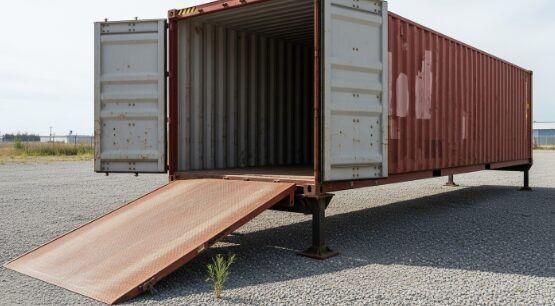
Container floors sit roughly 130–150mm above ground level, depending on the condition of the base and whether levelling equipment has been used. That is not a large step in absolute terms, but it is enough to make moving anything heavy on wheels — a pallet truck, a sack truck, a wheelbarrow — impractical without a ramp.
Steel container ramps are available in fixed and folding configurations. Fixed ramps are more stable under heavy loads and suit permanent installations where the container is not being relocated. Folding ramps are more practical where the container is moved regularly, or where the ramp needs to be removed and secured when the container is not in use.
The specification that matters most is the load rating. A ramp suitable for foot traffic and sack trucks is a different product to one that needs to take a forklift. Always check the rated capacity against the heaviest thing you plan to move across it.
For personnel access on converted containers — site offices, welfare units, and similar — a set of steel access steps with a non-slip surface is often more appropriate than a loading ramp, and cheaper. Steps provide a more stable, comfortable entry point for regular foot traffic.
Racking and shelving: making the interior usable
How you organise the interior of a container determines how useful it actually is day to day. Wall-mounted racking brackets that attach to the corrugated steel panels give you adjustable shelf tiers without eating into floor space. The full range of container parts and accessories from Universal Containers which covers racking alongside other fittings like levelling equipment, vents, and security hardware, gives a useful sense of what is available off the shelf for most standard setups.
The corrugated profile of a container wall is not flat, so standard domestic or industrial shelving brackets do not sit flush against it. Container-specific racking systems are designed with this in mind, engaging with the corrugations to provide a stable mounting without the bracket rocking on the ridges.
For tool storage, the priority is visibility and access. Shallow shelving with items stored front-to-back rather than stacked deep means you can see and reach everything without moving other things out of the way. For stock storage, deeper shelving with consistent bin sizes keeps things tidy and makes inventory management straightforward.
Freestanding racking units are an alternative to wall-mounted systems and require no fixings at all. They are easier to reconfigure but take up more floor area and are less stable in an environment where the container is moved between sites.
Personnel doors and windows: converting a container for regular use
A standard container door is designed for cargo access. It opens 270 degrees, takes up a significant amount of space when open, and is not well-suited to regular in-and-out use by people. For containers being used as offices, welfare units, workshops, or any other purpose involving frequent personnel access, fitting a personnel door in one of the side or end walls makes daily use considerably more practical.
Personnel doors come in steel and aluminium versions, with a range of security ratings. For a site store with moderate security requirements, a basic steel door with a standard lockset is usually sufficient. For converted containers used as offices or accommodation, a more substantial specification with a multipoint lock and better weather sealing is worth considering.
Windows serve two purposes beyond the obvious one of letting light in. Natural light inside a container reduces the reliance on powered lighting and makes the space more comfortable to work in for extended periods. Windows also provide passive ventilation — opening a window on the opposite side of the container from the door creates a cross-flow that helps with both temperature and condensation control.
Both personnel doors and windows involve cutting apertures in the container panels, which is work for a fabricator with appropriate equipment. It is not particularly complex work, but it does need to be done properly to maintain the structural integrity of the wall and ensure the fittings seal correctly against weather ingress.
Paint and surface protection: keeping the exterior in good condition
Used containers arrive with cosmetic wear — surface rust patches, scratches, and often a fairly tired exterior paint finish. That is not a structural problem in most cases, but left unaddressed, surface rust will spread and eventually become one.
Container-specific paint is formulated to adhere to Corten steel and withstand the expansion and contraction that comes with temperature changes. Standard exterior masonry or metal paints do not handle that movement as well and tend to crack and peel over time. A proper preparation — removing loose rust and surface contamination before painting — makes a significant difference to how long the finish lasts.
For containers that are going to be visible and need to look reasonable — a pop-up retail unit, a converted office in a client-facing location — a full respray in a chosen RAL colour transforms the appearance substantially. Most container suppliers will carry out a respray before delivery as a standard service. If you are painting an existing container on site, wire brushing or light blasting is usually sufficient preparation for a decent result.
Lashing equipment: securing loads in transit
For containers that are moved between sites with goods inside — or used for temporary storage on hire arrangements where the contents are loaded and unloaded regularly — lashing equipment prevents stock, equipment, and materials from shifting during transit.
Standard ISO containers have lashing rings built into the floor and walls at fixed intervals, rated for specific loads. Ratchet straps or cargo lashing bars connect between these rings and pass over or around the load. The key is to use the correct rated strap for the weight being secured — using underrated equipment is both unsafe and likely to damage the goods if the load shifts.
The Driver and Vehicle Standards Agency (DVSA) publishes guidance on load securing requirements for road transport, which applies to any vehicle carrying a loaded container. If you are moving a container by road with goods inside, understanding those requirements is worthwhile before the truck leaves the yard.
Starting with the right accessories, not retrofitting later
The temptation when buying a container is to start using it and add things as the need becomes obvious. It works in practice, but it is less efficient than thinking through the intended use beforehand and specifying accordingly.
Security hardware, ventilation, and levelling are the three things most people wish they had sorted before the container arrived rather than after. A lock box without the right padlock is pointless. A container sitting unlevel will not close properly. And a container with no additional ventilation beyond the factory vents will develop condensation problems in the first cold spell, usually before you have had a chance to do anything about it.
None of these accessories are expensive relative to the cost of a container. Sorting them at the point of purchase, or at least planning for them before the delivery, avoids having to deal with problems that were entirely foreseeable.