
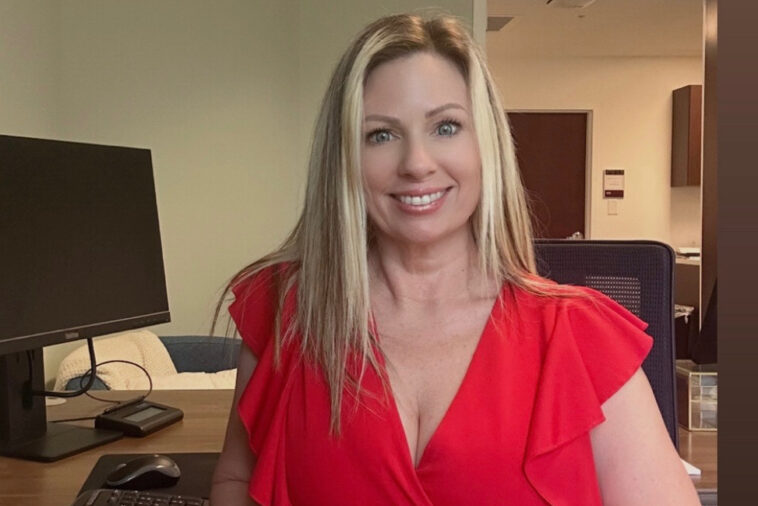
Cassie Newlun said she remembers the first time she laughed in years. The light feeling in her body had a glimpse of familiarity but was something she had not experienced since before she was in the depths of substance abuse.
Now serving as the Director of Nursing at the newly opened Recovery Centers of America in Mount Dora, Newlun said her personal journey with recovery allows her to truly see her patients and understand what they are going through.
“They know we’re speaking the same language, basically. That can make all the difference, because when the patient walks through the door here, which is sometimes the most difficult thing that the patient can do, is getting through that door, they’re giving up everything, their independence, their phone, their ability to feed themselves, everything,” Newlun said. “Now they’re going to rely on us for all those things, and I think that is so difficult. But I also think because they walked in the door, that there is something left of them, where they do want to live a better life.”
The RCA in Mount Dora is Florida’s first location and the second in the Southeast, alongside Greenville. The campus spans 19 acres and includes seven buildings, a pond, an outdoor recreation area with a basketball court and a rock-climbing wall, and 124 patient beds.


In addition to the amenities, RCA’s care includes family programming, virtual and in-person family support groups, and educational webinars. After completing treatment, patients will be enrolled into RCA’s alumni program for continued support, accountability and long-term connection.
Newlun said when she was looking for somewhere to work, it had to be California or Florida due to how important she finds sunshine to be for the healing process. She describes substance abuse as the feeling of having a storm cloud stuck over you, following you, so she said she finds sunshine to be essential. Being a part of the first RCA in Florida, she said, she is excited to see the impact she and her team of nurses can make on Central Florida.
“To be the first one [in Florida], I feel really excited. To be here in the beginning, when we were opening, I just couldn’t wait,” Newlun said. “I think of Field of Dreams, like ‘if you build it, they will come,’ kind of thing. We want it to be an amazing place that people want to come to.”
Newlun said her personal journey with substance abuse started when she no longer felt the mental pain she endured from her abusive high school ex-boyfriend while she was on pain medications from a surgery. The numbing feeling lessened pain and transitioned into a gradual addiction, where she realized she was counting her pills and getting nervous when her bottles were low. Terrified to ask a doctor for more medication, she headed to the streets to feed her needs.
She later went on to graduate from nursing school and said she felt her addiction was getting a bit stronger. She found out she had cancer, and due to a surgery gone wrong, she was no longer able to work as a nurse, which brought her to a very dark place.
Newlun said she never went to therapy, as she said it was not as normalized at the time, and felt like she could handle her problems on her own without asking for help. She began to mask her addiction, keeping it a secret from those she was close to and feeling like she had a chain around her ankle tied to her substance.
“I could only go so far because I had to be around that substance. I couldn’t go places with my family. I couldn’t go out on the boat, because I had to know that I could be close to that,” Newlun said. “At the time, thought that I had a handle on it, because I didn’t use it all, and I [was] able to put some away, and therefore it felt like I was controlling it, not really realizing it had control over me.”
She began to hang out with others who were also abusing substances, leading her to eventually go to jail. Her options were to stay in jail for 90 days or go to a rehabilitation facility for 18 months; she chose jail. Her time there allowed her to get clean and connect with her “higher power.” She began reading the Bible, praying and whenever someone would sneak a substance into jail, she said she was able to deny any temptations.
Once released, she did relapse, which she said is typical of someone dealing with addiction. She was kicked out of the house by her family and began couch-hopping from friends’ places. Eventually, she said she was homeless and lived on the streets.
“It was so degrading. I mean, here I am. I have an associate’s degree in nursing. I was working for years as a nurse. I had a family, everything, and I’ve given it all up, and I’m lying on the street trying to find something to sleep on,” Newlun said.
She said she realized she needed to humble herself and acknowledge her need for help. Once the “pain was great enough,” she decided to go to rehab, where she learned how to surrender and open up about her addiction. Newlun said she realized how substance abuse thrives off someone who isolates themselves.
“It’s not that anyone ever wants to grow up and be a drug addict. No one ever said that. It’s just you get so stuck in this altered reality that you don’t even realize the life that is going on out there, and you think that your life is over,” Newlun said. “People, places and things are the three things you’re supposed to change. Had I not changed those things, I don’t think that I would be here today. Actually, I know I wouldn’t be here today.”
Surviving health issues without pain medications was a step in the right direction for Newlun, where she said she realized she did not need to rely on anything aside from herself.


“I made it through all these things, and I do think all these things I’ve gone through were meant to happen. It was my journey, and it is so that I can share that with others,” Newlun said. “Because, you know, people just get stuck, and they don’t really realize there could be another life, and they don’t know that the grass is definitely greener on the other side. So I’m definitely glad that I did go through that to get me where I am today.”
After fighting to get her nursing license back, Newlun was back to helping others and doing what she is passionate about. Now serving as the Director of Nursing at the first RCA facility in Florida, she ensures her team of nurses is providing all-around quality care to patients, beyond just supplying medications. She said they prioritize conversations with patients and families on progress and working through difficult days together.
Following the mission statement of “saving a million lives, one person at a time,” Newlun said RCA treats patients individually.
“We know that it’s not a one-size-fits-all, and that people have different needs. I think that everyone who comes through the program here leaves a better person, and we try to keep them on a productive, successful path, and of course, have them give back as well. Even if you know they relapse, they know they have a safe place to return to,” Newlun said.
Newlun said she connects to her patients, especially the women she works with, since she was once fighting the battles they are now. Having that understanding with those she treats, she said, she hopes to show how life can look after recovery.
“I think being in the role will help them to know that they should actually set their expectations high. They should not limit themselves, and they should shoot for the impossible. Because the only bad thing that’s going to happen is that you might have failed trying, rather than not trying at all,” Newlun said. “I want them to know that I never thought back then that I was going to have a life as I do now.”