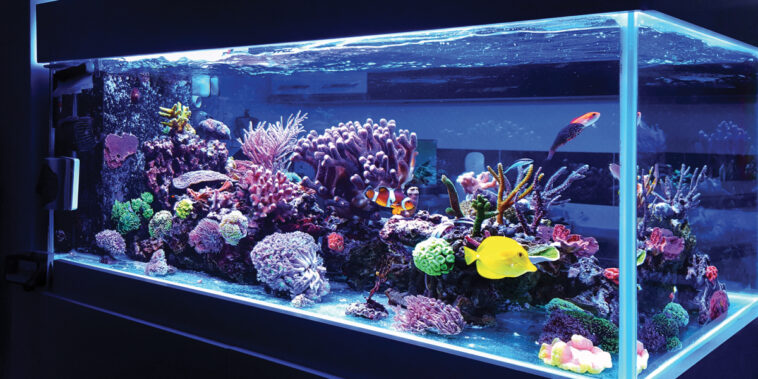
Key facts
- Choose a location away from windows, direct sunlight, heat vents and air conditioners to avoid stressing fish and corals with temperature swings [1]
- Test your tank stand for level by filling it with one to two inches of water and checking that the water sits evenly on all four sides [1]
- Wait four to six weeks for your tank to cycle before adding any livestock, even though additives like Brightwell Aquatics MicroBactor 7 can speed the process [1]
Today, those same fundamentals still hold true for Central Florida hobbyists ready to dive into the hobby [1].
Finding the Right Spot
Location matters more than most beginners realize. Your tank should sit away from windows, outside doors, heat vents and air conditioners, since rapid temperature changes stress fish and live corals [1]. Place it in a room where you’ll spend considerable time, but ensure the floor can bear the weight. If you rent, check your lease first—many apartments and condos restrict aquarium sizes [1].
You’ll need access to at least four electrical outlets for pumps, heaters, lights and other equipment [1]. Leave enough space behind the tank for filters and maintenance access [1].
Building Your Foundation

Start by rinsing any dust from the inside of the tank before positioning the stand. Level is critical—use a carpenter’s level, or fill the tank with one to two inches of water and check that it sits evenly on all sides [1]. An unbalanced tank can crack or leak and may void your warranty [1].
Fill the tank about one-third full and check for leaks by looking for water beading on the bottom edge or running down the stand sides [1]. If you find a leak, return the tank; repairs rarely succeed [1].
Set up your filter and protein skimmer according to the manufacturer’s instructions, but don’t plug them in yet [1].
Sand and Live Rock
Rinse live sand in premixed saltwater before adding it to your tank, then discard the rinse water [1]. Live rock—whether harvested from the ocean or manufactured—provides biological filtration and habitat for beneficial microorganisms [1].
Despite its name, “live rock” isn’t actually living; it consists of aragonite skeletons from dead corals and other marine organisms that form natural reef structures [1]. Ocean-sourced rock typically comes encrusted with coralline algae and inhabited by countless microscopic marine life that colonize the porous structure [1].
Filling and Chemistry
Once you’ve confirmed no leaks, fill the tank completely, pouring water onto a small bowl or saucer to protect your aquascaping [1]. Check again for leaks [1].
Add water conditioner and commercial marine salt gradually until your hydrometer reads a specific gravity of around 1.020 [1]. For fish-only tanks, aim for 1.020 to 1.025; for reef tanks with live corals, target 1.023 to 1.025 [1]. Wait up to 24 hours for the specific gravity to stabilize before making final adjustments [1].
Place your heater in the tank or filtration area but don’t plug it in yet [1]. Clip-on, non-submersible heaters work best near the filter’s outflow; submersible heaters should sit near the inflow to distribute heated water evenly [1].
The Wait
After 20 minutes, plug in your heater and protein skimmer, then top off water if needed [1]. Follow the heater’s instructions to set your target temperature [1].
Don’t rush to buy fish. Your temperature and specific gravity must remain stable for at least 24 to 48 hours while atmospheric gases escape [1]. Cloudiness is normal—wait for it to clear before proceeding [1].
Once conditions have stabilized and cloudiness disappears, your tank enters the cycling phase. This takes four to six weeks before the tank is ready for livestock [1]. Additives like Brightwell Aquatics MicroBactor 7 can accelerate the cycle, but patience remains your best strategy [1].
Lou Schiavo is co-founder and chief operations officer of World Wide Corals, established in 2006 in Central Florida and serving aquarium hobbyists worldwide [1].
Frequently asked questions
Why is tank placement so important?
Rapid temperature changes from sunlight, heat vents, or air conditioning are extremely stressful for fish and corals. Placing your tank away from these sources helps maintain stable conditions [1].
How do I know if my tank stand is level?
Fill the tank with one to two inches of water and check that the water sits an even distance from the top on all four sides. An unbalanced tank risks cracking or leaking [1].
How long before I can add fish?
After setup, wait 24 to 48 hours for temperature and specific gravity to stabilize. Then your tank must cycle for four to six weeks before it’s ready for livestock [1].
What is live rock and why do I need it?
Live rock is made from aragonite skeletons of dead corals and is colonized by beneficial microorganisms. It provides biological filtration and a natural habitat for tank inhabitants [1].
Sources
- How to Set Up a Saltwater Aquarium – Central Florida Lifestyle, 2021-07-16
Originally published by Central Florida Lifestyle on 2021-07-16; updated October 12, 2026 with current information.