


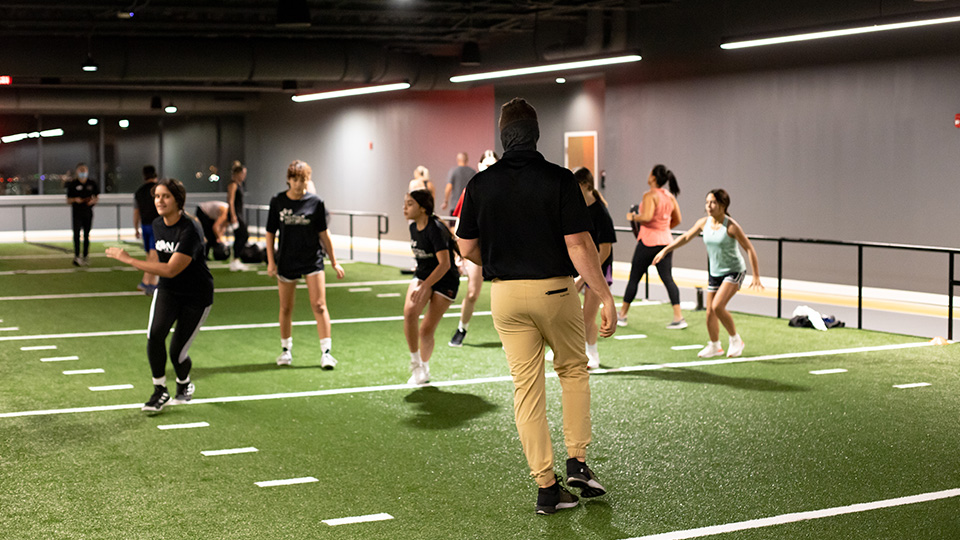
Movement as Medicine is to educate everyone on understanding the functional movement patterns of the body, and how to use movement to optimize performance and overall daily function. Understanding how the body moves, how to train movement, and utilizing movement are all essential in developing pain free longevity and performance.
Movement in life and in athletics happens in three planes of motion:
- Sagittal plane: Any movement that happens “front to back” or forward.
- Frontal plane: Any movement that happens “side to side” or laterally.
- Transverse plane: Any rotational movement.
All movement in life falls within these planes, either one at a time or some combination of them together. Understanding that all three of these planes need focus within your training can help to optimize your movement quality and performance.
Every joint in the body has a function, and either acts as a mobile or a stable joint as it pertains to movement. As we work our way up the kinetic chain from the ground up, the needs of each joint alternate between mobility and stability. This is a simple way to understand how to program movements. Using the joint-by-joint approach, we can now understand if these joints lack the mobility or stability that they require and then program to correct those deficiencies.
For training, we focus on movements and not muscles- multi joint, multi planar “bang for your buck” movements that help to optimize the functionality of your body. To properly plan and program it’s important to understand various categories of movement. For our upper body training, we simplify our exercises by categorizing them as a horizontal pull, horizontal press, vertical pull, or vertical press movements. For our lower body training, we look at bilateral squat patterns, unilateral squat patterns, posterior chain dominant movements and hinge patterns. For our core work, we categorize movements as rotational movements, anti-rotation movements, anti-extension/flexion movements and loaded carries. By categorizing movements, it allows us to essentially “plug and play” exercises based on the movement goal and the progress or regress each of these movements based on the individual needs of the client.
In terms of progressing or regressing movements or exercises, we focus on manipulating four variables:
- Increase or decrease the intensity of the movement through higher or lower weight.
- Increase or decrease the overall volume of the movement by adding or taking away reps.
- Increase the time under tension for each movement by manipulating the tempo of the eccentric, isometric or concentric portion of the movement.
- Challenge the difficulty of the movement by manipulating the plane of motion by focusing on triplanar patterns.
- This could include changing from a reverse lunge to a lateral lunge, a bilateral dumbbell bench press to a unilateral bench press, a strict shoulder press to a combination squat to press, etc.
At the end of the day, there are numerous ways to achieve success in your training but focusing on movement and understanding how the body functions can get you on the right track to every day optimized performance.
Comments

