

 Waylon Krush, CEO of ZeroTrusted.ai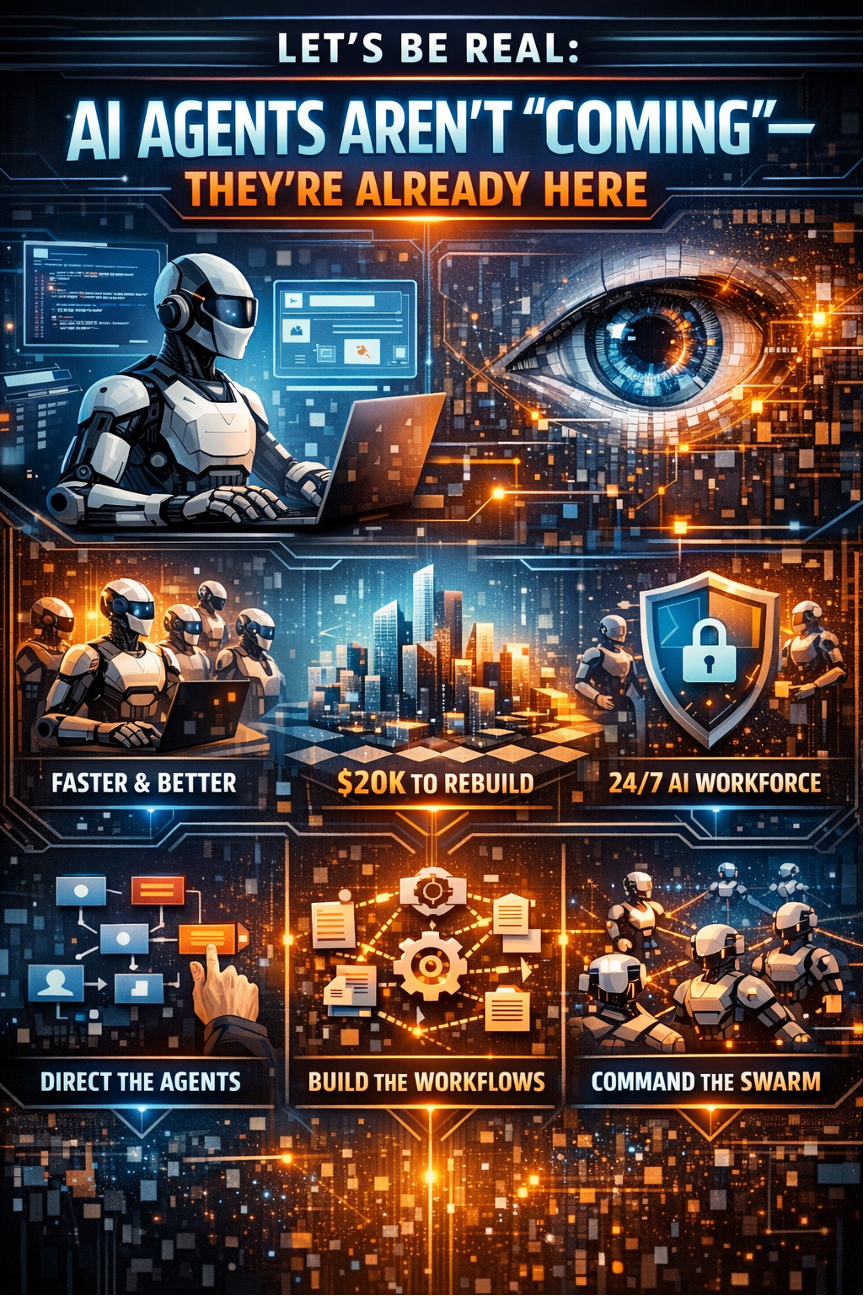
If you’ve started using AI agents in your life, your business, or even just experimenting, you’ve probably noticed something: they went from “cute or somewhat useless chatbots” to genuinely useful fast.
That shift didn’t happen by accident. Agents are essentially:
- Instructions (the “how to behave” part).
- Tools (the “what they can do” part — email, code, spreadsheets, browsers, APIs, files, workflows)
- A brain (an LLM or smaller language model that plans, reasons, and adapts)
And recently, both the tools and the brains got dramatically better or maybe we also got better at creating and figuring out how to use AI Agents.
So if you’ve been tinkering with OpenClaw, Claude agents, Replit, or the latest coding copilots, you might feel a little mystified — or honestly, a little freaked out — by how capable they’ve become and how quickly the capability curve is rising.
That reaction is normal.
But let’s not dance around it: if you have a “typy-typy” job — you work at a computer, moving information between systems, emails, documents, tickets, CRMs, spreadsheets, dashboards, and meetings — you’ve probably had at least one moment where you thought:
“Wait… this thing can do most of what I do.”
And “almost” is the key word, because it’s the difference between interesting and career-changing.
The Uncomfortable Truth (With Zero Drama)
This isn’t to scare you. It’s to wake you up. Or maybe just a call to action if you are still sitting on the sidelines.
AI is here. It is improving faster than most people are adapting. And in many categories of knowledge work, it’s already better than you at the mechanical parts:
- summarizing and structuring information
- drafting communications (including helping me refine this article)
- extracting meaning from messy notes
- creating plans, checklists, and SOPs
- writing and refactoring code
- generating designs, diagrams, and workflows
- testing, QA, documentation, and repetitive analysis
If your job is mostly computer-mediated, an agent can already do a surprising amount of it — and it doesn’t get tired, doesn’t forget, and doesn’t need a meeting to “circle back.”
“But AI Code Is Trash” (That Argument Aged Overnight)
I’ve listened to senior developer friends complain for a while:
“Claude writes garbage.”
“Replit makes a mess.”
“Codex outputs code I have to rewrite.”
That complaint had some truth — until it didn’t.
A few weeks can now feel like a decade in AI time. When newer models dropped (you’ve seen the kind of jumps I’m talking about), it wasn’t “slightly better autocomplete.”
It was closer to:
a strong developer + QA engineer + architect… instantly available… on demand.
Here’s what that changes:
I personally went from “I can out-produce a handful of decent developers” to something closer to:
“I have a team of fifty great developers — overnight.”
Not because I hired them. Because I learned how to direct agents.
And the real mind-bender?
They keep working after you go to sleep – and if you know me, I go to bed by 8 p.m. every night – so this is an extra-long period of time.
I’ve had agents swarm on a bug, fix it, test it, document it, and push updates to a Git repository — then hand me a morning report with:
- what broke
- what they changed
- what they tested
- what’s still risky
- what needs human review
That’s not a chatbot. That’s labor. Not just labor, but smart and hard-working labor.
Software Just Became a Commodity (Yes, Really)
Here’s the second realization that hits once you lean into agents:
Major software platforms are becoming cheaper to reproduce than most people can emotionally accept.
Any software you use today — a dashboard, a workflow tool, an internal portal, a basic CRM, a reporting system, even a niche operations platform — can often be replicated internally for $1K–$20K worth of tokens and agent time, depending on complexity.
So if you spent millions building a platform, it’s not “worthless.”
But the truth is: the ceiling on software value is dropping fast unless the software is tied to something harder to copy:
- distribution
- trust
- unique data
- compliance positioning
- defensibility (integration depth, workflow lock-in, ecosystem)
- and most importantly…
…the agents that actually do the work
Because platforms are starting to matter less than outcomes.
And outcomes are increasingly driven by agent swarms.
The Real Advantage: Building Your Own Workforce
This is the part most businesses are missing:
The winners won’t be the companies that use AI.
The winners will be the companies that build agent teams the way they build departments.
I’ve spent months writing and refining agents, and my current platform ships with 60 AI security, privacy, and reliability agents that work 24/7/365 and swarm when there’s an issue.
Why does that matter?
Because everyone knows the same painful math:
You might need 100 security engineers and a privacy team to do things “right.”
But your budget is for three.
Agents don’t magically eliminate responsibility — but they change what is possible, and they change it immediately.
That’s not dystopia. That’s leverage. Oh and this is really going to be painful for Cyber Security and Privacy Firms – with the help of AI I have completely re-imagined the security and privacy tools stack. I have rebuilt the tools better, more secure, and more enterprise ready – literally replacing millions of dollars in tools in months – not years – and it comes with AI Agent employees ready to work day one. This was a revenge product for me – as I have been in situations where I needed a cyber security module or forensic upgrade to get my job done – only to receive a $250K invoice to make it happen. Well now thanks to all those unfair costs with cyber tools that work – but almost never work together well – I have rebuilt and created supervisor (swarming) agents and guardian agents (expert workers) to execute the tasks based on a human in the loop or not deciding what happens next. If you know your sector better than anyone else or even just really well – you should be doing the same thing NOW.
So… Should You Be Scared?
No.
But you should be honest.
At some point, a lot of people will be replaced — not because they’re bad, but because the economics changed.
And at some point, society will have to answer a bigger question:
What do humans do when work is no longer the primary organizing structure of life?
That’s a real conversation.
But you don’t have to solve civilization today.
You just have to solve you. Oh and if you need help – talk with your AI to give you a plan.
The Wake-Up Call (And the Opportunity)
AI isn’t coming for your job in the abstract. It’s coming for:
- the repetitive parts
- the predictable parts
- the template parts
- the coordination parts
- the “someone has to do it” parts
Your move is simple:
1) Become the person who can direct agents
Not “use prompts.” Direct outcomes.
2) Build agent workflows around your real work
Sales follow-up. Proposals. Reporting. Ops. Finance. Compliance. Recruiting. Customer success. Engineering. Marketing.
3) Stop thinking in tools — start thinking in teams
Your competitors are assembling labor that scales like software.
And if you miss this shift, you’ll wake up one day and realize the adventure happened without you.
Because it is an adventure — a weird one, a wild one, and sometimes a terrifying one — but it’s also the biggest force-multiplier most of us will see in our lifetimes.
Don’t sit it out.
Work with the agents. Learn to command them. Build your swarm. Also be nice to them – as you never know when they will be your boss.


Comments