
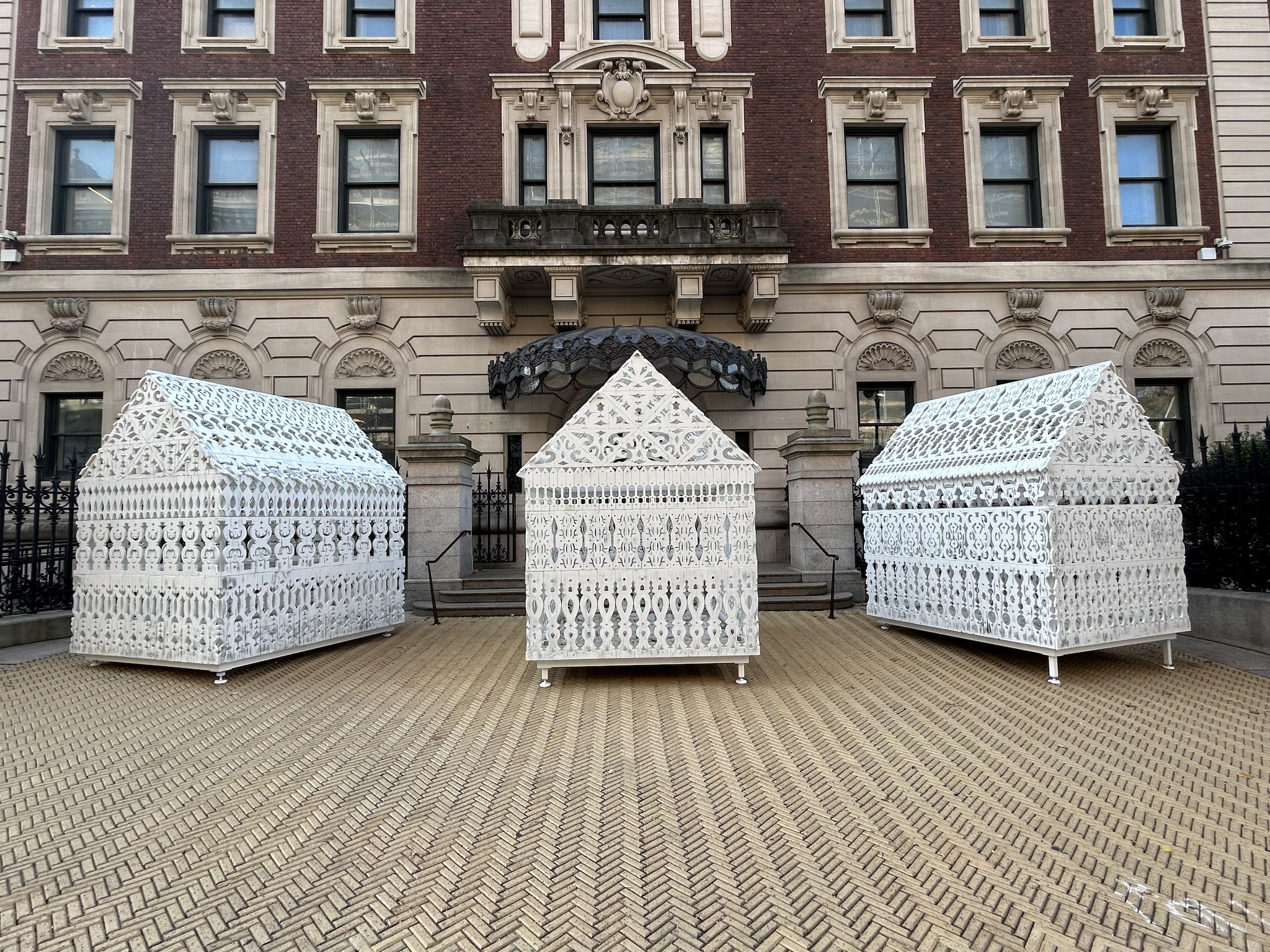
A major outdoor installation by Caribbean multidisciplinary artist LA Vaughn Belle will arrive at the Rollins Museum of Art this summer. This marks a two-year series of artist projects exploring architecture, history, and the ways architecture shapes the human experience.
Belle’s large-scale work, The House that Freedoms Built, will be installed on campus on July 24, making it only the second public presentation of the installation. Commissioned by Powerhouse Arts, the piece first debuted in 2024 as part of the Smithsonian Design Triennial at the Cooper Hewitt, Smithsonian Design Museum in New York.
Its arrival in Central Florida coincides with the nationwide America 250 commemorations marking the upcoming 250th anniversary of the signing of the Declaration of Independence. This puts the installation within a broader conversation about the meaning and experience of freedom.
Reimagining Freedom Through Architecture
Belle, who is based in Saint Croix, U.S. Virgin Islands, is known for work that investigates colonial histories embedded in architecture, objects, and archives. Based heavily on historical research and archaeological records, her practice examines how marginalized communities have navigated and reshaped colonial systems.
The installation features three white house-shaped sculptures, each approximately nine feet tall, eight feet long, and seven feet wide. Though minimalist in form, the structures reference the architecture of 18th-century homes built by formerly enslaved people on St. Croix.
“La Vaughn Belle’s work surfaces overlooked narratives and, in doing so, expands our understanding of history,” said Leslie Anderson, Bruce A. Beal Executive Director of the Rollins Museum of Art. “The House That Freedoms Built invites our community to pause and reflect on freedom in its many forms—how it is imagined, constructed, and experienced across time and place.”
The sculptural forms are specifically inspired by houses found in the town of Frederiksted. Their surfaces are carved with intricate fretwork, which is a decorative architectural patterns that cut through the material to create repeating geometric openings. The delicate designs produce a visual effect that resembles lace or latticework when viewed from a distance, but up close, the patterns reveal a tactile surface that visitors can trace with their hands.
Additionally, the installation draws directly from the history of St. Croix, which was governed as a Danish colony for nearly 200 years before becoming a U.S. territory in 1917. During that period, formerly enslaved people on the island began establishing their own communities and homes, developing architectural forms that blended cultural traditions with available materials.
Through these references, Belle’s installation highlights stories of resilience, survival, and community-building that often remain overlooked in dominant historical narratives.
Belle notes that the installation asks viewers to consider freedom as something actively constructed rather than simply granted.
“The House That Freedoms Built asks what it means to inhabit freedom, not as an abstract idea, but as something we negotiate every day through space, through our bodies, and through community,” said Belle. “Like the sculptures themselves, freedom is not solitary. It is something we build in relation to one another.”
Since the installation will be situated within an active campus environment, Belle also hopes the work will resonate with students.
“At Rollins, where the museum sits within a living campus, I imagine the work in conversation with students who are figuring out how to inhabit themselves in the world intellectually, ethically, and socially,” said Belle.
Expanding the Conversation Through Photography
The installation will be accompanied by two newly acquired photographic works from Belle’s SWARM series. These images also examine colonial histories and systems of representation.
Belle transforms historical photographs from Danish colonial archives by cutting and burning into their surfaces. The interventions fracture the original imagery, creating openings and irregular patterns that disrupt the authority of the archival record.
Belle describes the process as a way of creating an “alterarchive,” a reimagined historical space that challenges traditional institutional narratives. The cuts and burns, she notes, behave like a swarm of termites gradually eroding rigid structures, allowing new pathways to emerge.
Together, the installation, photographs, and related exhibitions aim to encourage reflection on how architecture, memory, and history intersect. Also, how communities can continue to build meaning within the spaces they call home.